AI for Business

Explore the best AI for Business — independent reviews, comparisons, pricing and step-by-step how-to guides, curated by Aizhi.

  • IT8

    IT8

    IT8 is a set of American National Standards Institute (ANSI) standards for color communications and control specifications. Formerly governed by the IT8 Committee, IT8 activities were merged with those of the Committee for Graphics Arts Technologies Standards (CGATS Archived November 9, 2018, at the Wayback Machine) in 1994. == Standards list == The following is a list of the IT8 standards, according to the NPES Standards Blue Book Archived July 19, 2011, at the Wayback Machine: === IT8.6 - 2002 - Graphic technology - Prepress digital data exchange - Diecutting data (DDES3) === This standard establishes a data exchange format to enable transfer of numerical control information between diecutting systems and electronic prepress systems. The information will typically consist of numerical control information used in the manufacture of dies. 37 pp. === IT8.7/1 - 1993 (R2003) - Graphic technology - Color transmission target for input scanner calibration === This standard defines an input test target that will allow any color input scanner to be calibrated with any film dye set used to create the target. It is intended to address the color transparency products that are generally used for input to the preparatory process for printing and publishing. This standard defines the layout and colorimetric values of a target that can be manufactured on any positive color transparency film and that is intended for use in the calibration of a photographic film/scanner combination. 32 pp. === IT8.7/2 - 1993 (R2003) Graphic technology - Color reflection target for input scanner calibration === This standard defines an input test target that will allow any color input scanner to be calibrated with any film dye set used to create the target. It is intended to address the color photographic paper products that are generally used for input to the preparatory process for printing and publishing. It defines the layout and colorimetric values of the target that can be manufactured on any color photographic paper and is intended for use in the calibration of a photographic paper/scanner combination. 29 pp. === IT8.7/3 - 1993 (R2003) Graphic technology - Input data for characterization of 4-color process printing === The purpose of this standard is to specify an input data file, a measurement procedure and an output data format to characterize any four-color printing process. The output data (characterization) file should be transferred with any four-color (cyan, magenta, yellow and black) halftone image files to enable a color transformation to be undertaken when required. 29 pp. == Targets == Calibrating all devices involved in the process chain (original, scanner/digital camera, monitor/printer) is required for an authentic color reproduction, because their actual color spaces differ device-specifically from the reference color spaces. An IT8 calibration is done with what are called IT8 targets, which are defined by the IT8 standards. Example Special targets, implementing the IT8.7/1 (transparent target) or IT8.7/2 (reflective target) standards, are needed for calibrating scanners. These targets consists of 24 grey fields and 264 color fields in 22 columns: Column 01 to 12: HCL color model, which differ in Hue, Chroma, and Lightness Column 13 to 16: CMYK-Colors Cyan, Magenta, Yellow, and Key (black) in different steps of brightness Column 17 to 19: RGB-Colors Red, Green, and Blue in different steps of brightness Column 20 to 22: undefined, producers' choice After scanning such a target, an ICC profile gets calculated on the basis of reference values. This profile is used for all subsequent scans and assures color fidelity.

    Read more →
  • Moral outsourcing

    Moral outsourcing

    Moral outsourcing is the placing of responsibility for ethical decision-making onto external entities, often algorithms. The term is often used in discussions of computer science and algorithmic fairness, but it can apply to any situation in which one appeals to outside agents in order to absolve themselves of responsibility for their actions. In this context, moral outsourcing specifically refers to the tendency of society to blame technology, rather than its creators or users, for any harm it may cause. == Definition == The term "moral outsourcing" was first coined by Dr. Rumman Chowdhury, a data scientist concerned with the overlap between artificial intelligence and social issues. Chowdhury used the term to describe looming fears of a so-called “Fourth Industrial Revolution” following the rise of artificial intelligence. Moral outsourcing is often applied by technologists to shrink away from their part in building offensive products. In her TED Talk, Chowdhury gives the example of a creator excusing their work by saying they were simply doing their job. This is a case of moral outsourcing and not taking ownership for the consequences of creation. When it comes to AI, moral outsourcing allows for creators to decide when the machine is human and when it is a computer - shifting the blame and responsibility of moral plights off of the technologists and onto the technology. Conversations around AI and bias and its impacts require accountability to bring change. It is difficult to address these biased systems if their creators use moral outsourcing to avoid taking any responsibility for the issue. One example of moral outsourcing is the anger that is directed at machines for “taking jobs away from humans” rather than companies for employing that technology and jeopardizing jobs in the first place. The term "moral outsourcing" refers to the concept of outsourcing, or enlisting an external operation to complete specific work for another organization. In the case of moral outsourcing, the work of resolving moral dilemmas or making choices according to an ethical code is supposed to be conducted by another entity. == Real-world applications == In the medical field, AI is increasingly involved in decision-making processes about which patients to treat, and how to treat them. The responsibility of the doctor to make informed decisions about what is best for their patients is outsourced to an algorithm. Sympathy is also noted to be an important part of medical practice; an aspect that artificial intelligence, glaringly, is missing. This form of moral outsourcing is a major concern in the medical community. Another field of technology in which moral outsourcing is frequently brought up is autonomous vehicles. California Polytechnic State University professor Keith Abney proposed an example scenario: "Suppose we have some [troublemaking] teenagers, and they see an autonomous vehicle, they drive right at it. They know the autonomous vehicle will swerve off the road and go off a cliff, but should it?" The decision of whether to sacrifice the autonomous vehicle (and any passengers inside) or the vehicle coming at it will be written into the algorithms defining the car's behavior. In the case of moral outsourcing, the responsibility of any damage caused by an accident may be attributed to the autonomous vehicle itself, rather than the creators who wrote the protocol the vehicle will use to "decide" what to do. Moral outsourcing is also used to delegate the consequences of predictive policing algorithms to technology, rather than the creators or the police. There are many ethical concerns with predictive policing due to the fact that it results in the over-policing of low income and minority communities. In the context of moral outsourcing, the positive feedback loop of sending disproportionate police forces into minority communities is attributed to the algorithm and the data being fed into this system--rather than the users and creators of the predictive policing technology. == Outside of technology == === Religion === Moral outsourcing is also commonly seen in appeals to religion to justify discrimination or harm. In his book What It Means to be Moral, sociologist Phil Zuckerman contradicts the popular religious notion that morality comes from God. Religion is oftentimes cited as a foundation for a moral stance without any tangible relation between the religious beliefs and personal stance. In these cases, religious individuals will "outsource" their personal beliefs and opinions by claiming that they are a result of their religious identification. This is seen where religion is cited as a factor for political beliefs, medical beliefs, and in extreme cases an excuse for violence. === Manufacturing === Moral outsourcing can also be seen in the business world in terms of manufacturing goods and avoiding environmental responsibility. Some companies in the United States will move their production process to foreign countries with more relaxed environmental policies to avoid the pollution laws that exist in the US. A study by the Harvard Business Review found that "in countries with tight environmental regulation, companies have 29% lower domestic emissions on average. On the other hand, such a tightening in regulation results in 43% higher emissions abroad." The consequences of higher pollution rates are then attributed to the loose regulations in these countries, rather than on the companies themselves who purposefully moved into these areas to avoid strict pollution policy.

    Read more →
  • Dynamic epistemic logic

    Dynamic epistemic logic

    Dynamic epistemic logic (DEL) is a logical framework dealing with knowledge and information change. Typically, DEL focuses on situations involving multiple agents and studies how their knowledge changes when events occur. These events can change factual properties of the actual world (they are called ontic events): for example a red card is painted in blue. They can also bring about changes of knowledge without changing factual properties of the world (they are called epistemic events): for example, a card is revealed publicly (or privately) to be red. Originally, DEL focused on epistemic events. Only some of the basic ideas are present in this entry of the original DEL framework; more details about DEL in general can be found in the references. Due to the nature of its object of study and its abstract approach, DEL is related and has applications to numerous research areas, such as computer science (artificial intelligence), philosophy (formal epistemology), economics (game theory) and cognitive science. In computer science, DEL is for example very much related to multi-agent systems, which are systems where multiple intelligent agents interact and exchange information. As a combination of dynamic logic and epistemic logic, dynamic epistemic logic is a young field of research. It really started in 1989 with Plaza's logic of public announcement. Independently, Gerbrandy and Groeneveld proposed a system dealing moreover with private announcement and that was inspired by the work of Veltman. Another system was proposed by van Ditmarsch whose main inspiration was the Cluedo game. But the most influential and original system was the system proposed by Baltag, Moss and Solecki. This system can deal with all the types of situations studied in the works above and its underlying methodology is conceptually grounded. This entry will present some of its basic ideas. Formally, DEL extends ordinary epistemic logic by the inclusion of event models to describe actions, and a product update operator that defines how epistemic models are updated as the consequence of executing actions described through event models. Epistemic logic will first be recalled. Then, actions and events will enter into the picture and we will introduce the DEL framework. == Epistemic logic == Epistemic logic is a modal logic dealing with the notions of knowledge and belief. As a logic, it is concerned with understanding the process of reasoning about knowledge and belief: which principles relating the notions of knowledge and belief are intuitively plausible? Like epistemology, it stems from the Greek word ϵ π ι σ τ η μ η {\displaystyle \epsilon \pi \iota \sigma \tau \eta \mu \eta } or ‘episteme’ meaning knowledge. Epistemology is nevertheless more concerned with analyzing the very nature and scope of knowledge, addressing questions such as “What is the definition of knowledge?” or “How is knowledge acquired?”. In fact, epistemic logic grew out of epistemology in the Middle Ages thanks to the efforts of Burley and Ockham. The formal work, based on modal logic, that inaugurated contemporary research into epistemic logic dates back only to 1962 and is due to Hintikka. It then sparked in the 1960s discussions about the principles of knowledge and belief and many axioms for these notions were proposed and discussed. For example, the interaction axioms K p → B p {\displaystyle Kp\rightarrow Bp} and B p → K B p {\displaystyle Bp\rightarrow KBp} are often considered to be intuitive principles: if an agent Knows p {\displaystyle p} then (s)he also Believes p {\displaystyle p} , or if an agent Believes p {\displaystyle p} , then (s)he Knows that (s)he Believes p {\displaystyle p} . More recently, these kinds of philosophical theories were taken up by researchers in economics, artificial intelligence and theoretical computer science where reasoning about knowledge is a central topic. Due to the new setting in which epistemic logic was used, new perspectives and new features such as computability issues were then added to the research agenda of epistemic logic. === Syntax === In the sequel, A G T S = { 1 , … , n } {\displaystyle AGTS=\{1,\ldots ,n\}} is a finite set whose elements are called agents and P R O P {\displaystyle PROP} is a set of propositional letters. The epistemic language is an extension of the basic multi-modal language of modal logic with a common knowledge operator C A {\displaystyle C_{A}} and a distributed knowledge operator D A {\displaystyle D_{A}} . Formally, the epistemic language L EL C {\displaystyle {\mathcal {L}}_{\textsf {EL}}^{C}} is defined inductively by the following grammar in BNF: L EL C : ϕ ::= p ∣ ¬ ϕ ∣ ( ϕ ∧ ϕ ) ∣ K j ϕ ∣ C A ϕ ∣ D A ϕ {\displaystyle {\mathcal {L}}_{\textsf {EL}}^{C}:\phi ~~::=~~p~\mid ~\neg \phi ~\mid ~(\phi \land \phi )~\mid ~K_{j}\phi ~\mid ~C_{A}\phi ~\mid ~D_{A}\phi } where p ∈ P R O P {\displaystyle p\in PROP} , j ∈ A G T S {\displaystyle j\in {AGTS}} and A ⊆ A G T S {\displaystyle A\subseteq {AGTS}} . The basic epistemic language L E L {\displaystyle {\mathcal {L}}_{EL}} is the language L E L C {\displaystyle {\mathcal {L}}_{EL}^{C}} without the common knowledge and distributed knowledge operators. The formula ⊥ {\displaystyle \bot } is an abbreviation for ¬ p ∧ p {\displaystyle \neg p\land p} (for a given p ∈ P R O P {\displaystyle p\in PROP} ), ⟨ K j ⟩ ϕ {\displaystyle \langle K_{j}\rangle \phi } is an abbreviation for ¬ K j ¬ ϕ {\displaystyle \neg K_{j}\neg \phi } , E A ϕ {\displaystyle E_{A}\phi } is an abbreviation for ⋀ j ∈ A K j ϕ {\displaystyle \bigwedge \limits _{j\in A}K_{j}\phi } and C ϕ {\displaystyle C\phi } an abbreviation for C A G T S ϕ {\displaystyle C_{AGTS}\phi } . Group notions: general, common and distributed knowledge. In a multi-agent setting there are three important epistemic concepts: general knowledge, distributed knowledge and common knowledge. The notion of common knowledge was first studied by Lewis in the context of conventions. It was then applied to distributed systems and to game theory, where it allows to express that the rationality of the players, the rules of the game and the set of players are commonly known. General knowledge. General knowledge of ϕ {\displaystyle \phi } means that everybody in the group of agents A G T S {\displaystyle {AGTS}} knows that ϕ {\displaystyle \phi } . Formally, this corresponds to the following formula: E ϕ := ⋀ j ∈ A G T S K j ϕ . {\displaystyle E\phi :={\underset {j\in {AGTS}}{\bigwedge }}K_{j}\phi .} Common knowledge. Common knowledge of ϕ {\displaystyle \phi } means that everybody knows ϕ {\displaystyle \phi } but also that everybody knows that everybody knows ϕ {\displaystyle \phi } , that everybody knows that everybody knows that everybody knows ϕ {\displaystyle \phi } , and so on ad infinitum. Formally, this corresponds to the following formula C ϕ := E ϕ ∧ E E ϕ ∧ E E E ϕ ∧ … {\displaystyle C\phi :=E\phi \land EE\phi \land EEE\phi \land \ldots } As we do not allow infinite conjunction the notion of common knowledge will have to be introduced as a primitive in our language. Before defining the language with this new operator, we are going to give an example introduced by Lewis that illustrates the difference between the notions of general knowledge and common knowledge. Lewis wanted to know what kind of knowledge is needed so that the statement p {\displaystyle p} : “every driver must drive on the right” be a convention among a group of agents. In other words, he wanted to know what kind of knowledge is needed so that everybody feels safe to drive on the right. Suppose there are only two agents i {\displaystyle i} and j {\displaystyle j} . Then everybody knowing p {\displaystyle p} (formally E p {\displaystyle Ep} ) is not enough. Indeed, it might still be possible that the agent i {\displaystyle i} considers possible that the agent j {\displaystyle j} does not know p {\displaystyle p} (formally ¬ K i K j p {\displaystyle \neg K_{i}K_{j}p} ). In that case the agent i {\displaystyle i} will not feel safe to drive on the right because he might consider that the agent j {\displaystyle j} , not knowing p {\displaystyle p} , could drive on the left. To avoid this problem, we could then assume that everybody knows that everybody knows that p {\displaystyle p} (formally E E p {\displaystyle EEp} ). This is again not enough to ensure that everybody feels safe to drive on the right. Indeed, it might still be possible that agent i {\displaystyle i} considers possible that agent j {\displaystyle j} considers possible that agent i {\displaystyle i} does not know p {\displaystyle p} (formally ¬ K i K j K i p {\displaystyle \neg K_{i}K_{j}K_{i}p} ). In that case and from i {\displaystyle i} ’s point of view, j {\displaystyle j} considers possible that i {\displaystyle i} , not knowing p {\displaystyle p} , will drive on the left. So from i {\displaystyle i} ’s point of view, j {\displaystyle j} might drive on the left as well (by the same argument as abov

    Read more →
  • Character computing

    Character computing

    Character computing is a trans-disciplinary field of research at the intersection of computer science and psychology. It is any computing that incorporates the human character within its context. Character is defined as all features or characteristics defining an individual and guiding their behavior in a specific situation. It consists of stable trait markers (e.g., personality, background, history, socio-economic embeddings, culture,...) and variable state markers (emotions, health, cognitive state, ...). Character computing aims at providing a holistic psychologically driven model of human behavior. It models and predicts behavior based on the relationships between a situation and character. Three main research modules fall under the umbrella of character computing: character sensing and profiling, character-aware adaptive systems, and artificial characters. == Overview == Character computing can be viewed as an extension of the well-established field of affective computing. Based on the foundations of the different psychology branches, it advocates defining behavior as a compound attribute that is not driven by either personality, emotions, situation or cognition alone. It rather defines behavior as a function of everything that makes up an individual i.e., their character and the situation they are in. Affective computing aims at allowing machines to understand and translate the non-verbal cues of individuals into affect. Accordingly, character computing aims at understanding the character attributes of an individual and the situation to translate it to predicted behavior, and vice versa. ''In practical terms, depending on the application context, character computing is a branch of research that deals with the design of systems and interfaces that can observe, sense, predict, adapt to, affect, understand, or simulate the following: character based on behavior and situation, behavior based on character and situation, or situation based on character and behavior.'' The Character-Behavior-Situation (CBS) triad is at the core of character computing and defines each of the three edges based on the other two. Character computing relies on simultaneous development from a computational and psychological perspective and is intended to be used by researchers in both fields. Its main concept is aligning the computational model of character computing with empirical results from in-lab and in-the-wild psychology experiments. The model is to be continuously built and validated through the emergence of new data. Similar to affective and personality computing, the model is to be used as a base for different applications towards improving user experience. == History == Character computing as such was first coined in its first workshop in 2017. Since then it has had 3 international workshops and numerous publications. Despite its young age, it has already drawn some interest in the research community, leading to the publication of the first book under the same title in early 2020 published by Springer Nature. Research that can be categorized under the field dates much older than 2017. The notion of combining several factors towards the explanation of behavior or traits and states has long been investigated in both Psychology and Computer Science, for example. == Character == The word character originates from the Greek word meaning “stamping tool”, referring to distinctive features and traits. Over the years it has been given many different connotations, like the moral character in philosophy, the temperament in psychology, a person in literature or an avatar in various virtual worlds, including video games. According to character computing character is a unification of all the previous definitions, by referring back to the original meaning of the word. Character is defined as the holistic concept representing all interacting trait and state markers that distinguish an individual. Traits are characteristics that mainly remain stable over time. Traits include personality, affect, socio-demographics, and general health. States are characteristics that vary in short periods of time. They include emotions, well-being, health, cognitive state. Each characteristic has many representation methods and psychological models. The different models can be combined or one model can be preset for each characteristic. This depends on the use-case and the design choices. == Areas == Research into character computing can be divided into three areas, which complement each other but can each be investigated separately. The first area is sensing and predicting character states and traits or ensuing behavior. The second area is adapting applications to certain character states or traits and the behavior they predict. It also deals with trying to change or monitor such behavior. The final area deals with creating artificial agents e.g., chatbots or virtual reality avatars that exhibit certain characteristics. The three areas are investigated separately and build on existing findings in the literature. The results of each of the three areas can also be used as a stepping stone for the next area. Each of the three areas has already been investigated on its own in different research fields with focus on different subsets of character. For example, affective computing and personality computing both cover different areas with a focus on some character components without the others to account for human behavior. == The Character-Behavior-Situation triad == Character computing is based on a holistic psychologically driven model of human behavior. Human behavior is modeled and predicted based on the relationships between a situation and a human's character. To further define character in a more formal or holistic manner, we represent it in light of the Character–Behavior–Situation triad. This highlights that character not only determines who we are but how we are, i.e., how we behave. The triad investigated in Personality Psychology is extended through character computing to the Character–Behavior–Situation triad. Any member of the CBS triad is a function of the two other members, e.g., given the situation and personality, the behavior can be predicted. Each of the components in the triad can be further decomposed into smaller units and features that may best represent the human's behavior or character in a particular situation. Character is thus behind a person's behavior in any given situation. While this is a causality relation, the correlation between the three components is often more easily used to predict the components that are most difficult to measure from those measured more easily. There are infinitely many components to include in the representation of any of C, B, and S. The challenge is always to choose the smallest subset needed for prediction of a person's behavior in a particular situation.

    Read more →
  • Quantum artificial life

    Quantum artificial life

    Quantum artificial life is the application of quantum algorithms with the ability to simulate biological behavior. Quantum computers offer many potential improvements to processes performed on classical computers, including machine learning and artificial intelligence. Artificial intelligence applications are often inspired by the idea of mimicking human brains through closely related biomimicry. This has been implemented to a certain extent on classical computers (using neural networks), but quantum computers offer many advantages in the simulation of artificial life. Artificial life and artificial intelligence are extremely similar, with minor differences; the goal of studying artificial life is to understand living beings better, while the goal of artificial intelligence is to create intelligent beings. In 2016, Alvarez-Rodriguez et al. developed a proposal for a quantum artificial life algorithm with the ability to simulate life and Darwinian evolution. In 2018, the same research team led by Alvarez-Rodriguez performed the proposed algorithm on the IBM ibmqx4 quantum computer, and received optimistic results. The results accurately simulated a system with the ability to undergo self-replication at the quantum scale. == Artificial life on quantum computers == The growing advancement of quantum computers has led researchers to develop quantum algorithms for simulating life processes. Researchers have designed a quantum algorithm that can accurately simulate Darwinian Evolution. Since the complete simulation of artificial life on quantum computers has only been actualized by one group, this section shall focus on the implementation by Alvarez-Rodriguez, Sanz, Lomata, and Solano on an IBM quantum computer. Individuals were realized as two qubits, one representing the genotype of the individual and the other representing the phenotype. The genotype is copied to transmit genetic information through generations, and the phenotype is dependent on the genetic information as well as the individual's interactions with their environment. In order to set up the system, the state of the genotype is instantiated by some rotation of an ancillary state ( | 0 ⟩ ⟨ 0 | {\displaystyle |0\rangle \langle 0|} ). The environment is a two-dimensional spatial grid occupied by individuals and ancillary states. The environment is divided into cells that are able to possess one or more individuals. Individuals move throughout the grid and occupy cells randomly; when two or more individuals occupy the same cell they interact with each other. === Self replication === The ability to self-replicate is critical for simulating life. Self-replication occurs when the genotype of an individual interacts with an ancillary state, creating a genotype for a new individual; this genotype interacts with a different ancillary state in order to create the phenotype. During this interaction, one would like to copy some information about the initial state into the ancillary state, but by the no cloning theorem, it is impossible to copy an arbitrary unknown quantum state. However, physicists have derived different methods for quantum cloning which does not require the exact copying of an unknown state. The method that has been implemented by Alvarez-Rodriguez et al. is one that involves the cloning of the expectation value of some observable. For a unitary U {\displaystyle U} which copies the expectation value of some set of observables X {\displaystyle {\mathsf {X}}} of state ρ {\displaystyle \rho } into a blank state ρ e {\displaystyle \rho _{e}} , the cloning machine is defined by any ( U , ρ e , X ) {\displaystyle (U,\rho _{e},{\mathsf {X}})} that fulfill the following: ∀ ρ ∀ X ∈ X {\displaystyle \forall \rho \forall X\in {\mathsf {X}}} X ¯ = X 1 ¯ = X 2 ¯ {\displaystyle {\bar {X}}={\bar {X_{1}}}={\bar {X_{2}}}} Where X ¯ {\displaystyle {\bar {X}}} is the mean value of the observable in ρ {\displaystyle \rho } before cloning, X 1 ¯ {\displaystyle {\bar {X_{1}}}} is the mean value of the observable in ρ {\displaystyle \rho } after cloning, and X 2 ¯ {\displaystyle {\bar {X_{2}}}} is the mean value of the observable in ρ e {\displaystyle \rho _{e}} after cloning. Note that the cloning machine has no dependence on ρ {\displaystyle \rho } because we want to be able to clone the expectation of the observables for any initial state. It is important to note that cloning the mean value of the observable transmits more information than is allowed classically. The calculation of the mean value is defined naturally as: X ¯ = T r [ ρ X ] {\displaystyle {\bar {X}}=Tr[\rho X]} , X 1 ¯ = T r [ R X ⊗ I ] {\displaystyle {\bar {X_{1}}}=Tr[RX\otimes I]} , X 2 ¯ = T r [ R I ⊗ X ] {\displaystyle {\bar {X_{2}}}=Tr[RI\otimes X]} where R = U ρ ⊗ ρ e U † {\displaystyle R=U\rho \otimes \rho _{e}U^{\dagger }} The simplest cloning machine clones the expectation value of σ z {\displaystyle \sigma _{z}} in arbitrary state ρ = | ψ ⟩ ⟨ ψ | {\displaystyle \rho =|\psi \rangle \langle \psi |} to ρ e = | 0 ⟩ ⟨ 0 | {\displaystyle \rho _{e}=|0\rangle \langle 0|} using U = C N O T {\displaystyle U=CNOT} . This is the cloning machine implemented for self-replication by Alvarez-Rodriguez et al. The self-replication process clearly only requires interactions between two qubits, and therefore this cloning machine is the only one necessary for self replication. === Interactions === Interactions occur between individuals when the two take up the same space on the environmental grid. The presence of interactions between individuals provides an advantage for shorter-lifespan individuals. When two individuals interact, exchanges of information between the two phenotypes may or may not occur based on their existing values. When both individual's control qubits (genotypes) are alike, no information will be exchanged. When the control qubits differ, the target qubits (phenotype) will be exchanged between the two individuals. This procedure produces a constantly changing predator-prey dynamic in the simulation. Therefore, long-living qubits, with a larger genetic makeup in the simulation, are at a disadvantage. Since information is only exchanged when interacting with an individual of different genetic makeup, the short-lived population has the advantage. === Mutation === Mutations exist in the artificial world with limited probability, equivalent to their occurrence in the real world. There are two ways in which the individual can mutate: through random single qubit rotations and by errors in the self-replication process. There are two different operators that act on the individual and cause mutations. The M operation causes a spontaneous mutation within the individual by rotating a single qubit by parameter θ. The parameter θ is random for each mutation, which creates biodiversity within the artificial environment. The M operation is a unitary matrix which can be described as: M = ( cos ⁡ ( θ ) s i n ( θ ) s i n ( θ ) − c o s ( θ ) ) {\displaystyle M={\begin{pmatrix}\cos(\theta )&sin(\theta )\\sin(\theta )&-cos(\theta )\end{pmatrix}}} The other possible way for mutations to occur is due to errors in the replication process. Due to the no-cloning theorem, it is impossible to produce perfect copies of systems that are originally in unknown quantum states. However, quantum cloning machines make it possible to create imperfect copies of quantum states, in other words, the process introduces some degree of error. The error that exists in current quantum cloning machines is the root cause for the second kind of mutations in the artificial life experiment. The imperfect cloning operation can be seen as: U M ( θ ) = I 4 + 1 2 ( 0 0 0 1 ) ⊗ ( − 1 1 1 − 1 ) ( c o s θ + i s i n θ + 1 ) {\displaystyle U_{M}(\theta )=\mathrm {I} _{4}+{\frac {1}{2}}{\begin{pmatrix}0&0\\0&1\end{pmatrix}}\otimes {\begin{pmatrix}-1&1\\1&-1\end{pmatrix}}(cos\theta +isin\theta +1)} The two kinds of mutations affect the individual differently. While the spontaneous M operation does not affect the phenotype of the individual, the self-replicating error mutation, UM, alters both the genotype of the individual, and its associated lifetime. The presence of mutations in the quantum artificial life experiment is critical for providing randomness and biodiversity. The inclusion of mutations helps to increase the accuracy of the quantum algorithm. === Death === At the instant the individual is created (when the genotype is copied into the phenotype), the phenotype interacts with the environment. As time evolves, the interaction of the individual with the environment simulates aging which eventually leads to the death of the individual. The death of an individual occurs when the expectation value of σ z {\displaystyle \sigma _{z}} is within some ϵ {\displaystyle \epsilon } of 1 in the phenotype, or, equivalently, when ρ p = | 0 ⟩ ⟨ 0 | {\displaystyle \rho _{p}=|0\rangle \langle 0|} The Lindbladian describes the interaction of the individual with the environment: ρ

    Read more →
  • Prompt engineering

    Prompt engineering

    Prompt engineering is the process of structuring natural language inputs (known as prompts) to produce specified outputs from a generative artificial intelligence (GenAI) model. Context engineering is the related area of software engineering that focuses on the management of non-prompt contexts supplied to the GenAI model, such as metadata, API tools, and tokens. It can also be defined as the practice of designing and refining input instructions given to a generative AI model to produce more accurate, relevant, or useful outputs. Effective prompt engineering involves understanding how a model interprets language, and may include techniques such as few-shot prompting, chain-of-thought prompting, and role assignment. It is increasingly considered a skill for working with large language models (LLMs) in both research and professional contexts. During the 2020s AI boom, prompt engineering became regarded as a business capability across corporations and industries. Employees with the title prompt engineer were hired to create prompts that would increase productivity and efficacy, although the individual title has since lost traction amid AI models that produce better prompts than humans and corporate training in prompting for general employees. Common prompting techniques include multi-shot, chain-of-thought, and tree-of-thought prompting, as well as the use of assigning roles to the model. Automated prompt generation methods, such as retrieval-augmented generation (RAG), provide for greater accuracy and a wider scope of functions for prompt engineers. Prompt injection is a type of cybersecurity attack that targets machine learning models through malicious prompts. == Terminology == The Oxford English Dictionary defines prompt engineering as "The action or process of formulating and refining prompts for an artificial intelligence program, algorithm, etc., in order to optimize its output or to achieve a desired outcome; the discipline or profession concerned with this." In 2023, prompt ("an instruction given to an artificial intelligence program, algorithm, etc., which determines or influences the content it generates") was the runner-up to Oxford's word of the year. === Prompt === A prompt is some natural language text that describes and prescribes the task that an artificial intelligence (AI) should perform. A prompt for a text-to-text language model can be a query, a command, or a longer statement referencing context, instructions, and conversation history. The process of prompt engineering may involve designing clear queries, refining wording, providing relevant context, specifying the style of output, and assigning a character for the AI to mimic in order to guide the model toward more accurate, useful, and consistent responses. When communicating with a text-to-image or a text-to-audio model, a typical prompt contains a description of a desired output such as "a high-quality photo of an astronaut riding a horse" or "Lo-fi slow BPM electro chill with organic samples". Prompt engineering may be applied to text-to-image models to achieve a desired subject, style, layout, lighting, and aesthetic. === Techniques === Common terms used to describe various specific prompt engineering techniques include chain-of-thought, tree-of-thought, and retrieval-augmented generation (RAG). A 2024 survey of the field identified over 50 distinct text-based prompting techniques, 40 multimodal variants, and a vocabulary of 33 terms used across prompting research, highlighting a present lack of standardised terminology for prompt engineering. Vibe coding is an AI-assisted software development method where a user prompts an LLM with a description of what they want and lets it generate or edit the code. In 2025, "vibe coding" was the Collins Dictionary word of the year. === Context engineering === Context engineering is a related process that focuses on the context elements that accompany user prompts, which include system instructions, retrieved knowledge, tool definitions, conversation summaries, and task metadata. Context engineering is performed to improve reliability, provenance and token efficiency in production LLM systems. The concept emphasises operational practices such as token budgeting, provenance tags, versioning of context artifacts, observability (logging which context was supplied), and context regression tests to ensure that changes to supplied context do not silently alter system behaviour. == Rationale == Research has found that the performance of large language models (LLMs) is highly sensitive to choices such as the ordering of examples, the quality of demonstration labels, and even small variations in phrasing. In some cases, reordering examples in a prompt produced accuracy shifts of more than 40 percent. === In-context learning === A model's ability to temporarily learn from prompts is known as in-context learning. In-context learning is an emergent ability of large language models. It is an emergent property of model scale, meaning that breaks in scaling laws occur, leading to its efficacy increasing at a different rate in larger models than in smaller models. Unlike training and fine-tuning, which produce lasting changes, in-context learning is temporary. Training models to perform in-context learning can be viewed as a form of meta-learning, or "learning to learn". === Prompting to estimate model sensitivity === Research consistently demonstrates that LLMs are highly sensitive to subtle variations in prompt formatting, structure, and linguistic properties. Some studies have shown up to 76 accuracy points across formatting changes in few-shot settings. Linguistic features significantly influence prompt effectiveness—such as morphology, syntax, and lexico-semantic changes—which meaningfully enhance task performance across a variety of tasks. Clausal syntax, for example, improves consistency and reduces uncertainty in knowledge retrieval. This sensitivity persists even with larger model sizes, additional few-shot examples, or instruction tuning. To address sensitivity of models and make them more robust, several evaluative methods have been proposed. FormatSpread facilitates systematic analysis by evaluating a range of plausible prompt formats, offering a more comprehensive performance interval. Similarly, PromptEval estimates performance distributions across diverse prompts, enabling robust metrics such as performance quantiles and accurate evaluations under constrained budgets. == Prompting techniques == === Multi-shot === A prompt may include a few examples for a model to learn from in context, an approach called few-shot learning. For example, the prompt may ask the model to complete "maison → house, chat → cat, chien →", with the expected response being dog. === Chain-of-thought === Chain-of-thought (CoT) prompting is a technique that allows large language models (LLMs) to solve a problem as a series of intermediate steps before giving a final answer. In 2022, Google Brain reported that chain-of-thought prompting improves reasoning ability by inducing the model to answer a multi-step problem with steps of reasoning that mimic a train of thought. Chain-of-thought techniques were developed to help LLMs handle multi-step reasoning tasks, such as arithmetic or commonsense reasoning questions. When applied to PaLM, a 540 billion parameter language model, according to Google, CoT prompting significantly aided the model, allowing it to perform comparably with task-specific fine-tuned models on several tasks, achieving state-of-the-art results at the time on the GSM8K mathematical reasoning benchmark. It is possible to fine-tune models on CoT reasoning datasets to enhance this capability further and stimulate better interpretability. As originally proposed by Google, each CoT prompt is accompanied by a set of input/output examples—called exemplars—to demonstrate the desired model output, making it a few-shot prompting technique. However, according to a later paper from researchers at Google and the University of Tokyo, simply appending the words "Let's think step-by-step" was also effective, which allowed for CoT to be employed as a zero-shot technique. ==== Self-consistency ==== Self-consistency performs several chain-of-thought rollouts, then selects the most commonly reached conclusion out of all the rollouts. === Tree-of-thought === Tree-of-thought prompting generalizes chain-of-thought by generating multiple lines of reasoning in parallel, with the ability to backtrack or explore other paths. It can use tree search algorithms like breadth-first, depth-first, or beam. === Text-to-image prompting === In 2022, text-to-image models like DALL-E 2, Stable Diffusion, and Midjourney were released to the public. These models take text prompts as input and use them to generate images. Early text-to-image models typically do not understand negation, grammar and sentence structure in the same way as large language models, and may thus requi

    Read more →
  • Concept drift

    Concept drift

    In predictive analytics, data science, machine learning and related fields, concept drift or drift is an evolution of data that invalidates the data model. It happens when the statistical properties of the target variable, which the model is trying to predict, change over time in unforeseen ways. This causes problems because the predictions become less accurate as time passes. Drift detection and drift adaptation are of paramount importance in the fields that involve dynamically changing data and data models. == Predictive model decay == In machine learning and predictive analytics this drift phenomenon is called concept drift. In machine learning, a common element of a data model are the statistical properties, such as probability distribution of the actual data. If they deviate from the statistical properties of the training data set, then the learned predictions may become invalid, if the drift is not addressed. == Data configuration decay == Another important area is software engineering, where three types of data drift affecting data fidelity may be recognized. Changes in the software environment ("infrastructure drift") may invalidate software infrastructure configuration. "Structural drift" happens when the data schema changes, which may invalidate databases. "Semantic drift" is changes in the meaning of data while the structure does not change. In many cases this may happen in complicated applications when many independent developers introduce changes without proper awareness of the effects of their changes in other areas of the software system. For many application systems, the nature of data on which they operate are subject to changes for various reasons, e.g., due to changes in business model, system updates, or switching the platform on which the system operates. In the case of cloud computing, infrastructure drift that may affect the applications running on cloud may be caused by the updates of cloud software. There are several types of detrimental effects of data drift on data fidelity. Data corrosion is passing the drifted data into the system undetected. Data loss happens when valid data are ignored due to non-conformance with the applied schema. Squandering is the phenomenon when new data fields are introduced upstream in the data processing pipeline, but somewhere downstream these data fields are absent. == Inconsistent data == "Data drift" may refer to the phenomenon when database records fail to match the real-world data due to the changes in the latter over time. This is a common problem with databases involving people, such as customers, employees, citizens, residents, etc. Human data drift may be caused by unrecorded changes in personal data, such as place of residence or name, as well as due to errors during data input. "Data drift" may also refer to inconsistency of data elements between several replicas of a database. The reasons can be difficult to identify. A simple drift detection is to run checksum regularly. However the remedy may be not so easy. == Examples == The behavior of the customers in an online shop may change over time. For example, if weekly merchandise sales are to be predicted, and a predictive model has been developed that works satisfactorily. The model may use inputs such as the amount of money spent on advertising, promotions being run, and other metrics that may affect sales. The model is likely to become less and less accurate over time – this is concept drift. In the merchandise sales application, one reason for concept drift may be seasonality, which means that shopping behavior changes seasonally. Perhaps there will be higher sales in the winter holiday season than during the summer, for example. Concept drift generally occurs when the covariates that comprise the data set begin to explain the variation of your target set less accurately — there may be some confounding variables that have emerged, and that one simply cannot account for, which renders the model accuracy to progressively decrease with time. Generally, it is advised to perform health checks as part of the post-production analysis and to re-train the model with new assumptions upon signs of concept drift. == Possible remedies == To prevent deterioration in prediction accuracy because of concept drift, reactive and tracking solutions can be adopted. Reactive solutions retrain the model in reaction to a triggering mechanism, such as a change-detection test or control charts from statistical process control, to explicitly detect concept drift as a change in the statistics of the data-generating process. When concept drift is detected, the current model is no longer up-to-date and must be replaced by a new one to restore prediction accuracy. A shortcoming of reactive approaches is that performance may decay until the change is detected. Tracking solutions seek to track the changes in the concept by continually updating the model. Methods for achieving this include online machine learning, frequent retraining on the most recently observed samples, and maintaining an ensemble of classifiers where one new classifier is trained on the most recent batch of examples and replaces the oldest classifier in the ensemble. Contextual information, when available, can be used to better explain the causes of the concept drift: for instance, in the sales prediction application, concept drift might be compensated by adding information about the season to the model. By providing information about the time of the year, the rate of deterioration of your model is likely to decrease, but concept drift is unlikely to be eliminated altogether. This is because actual shopping behavior does not follow any static, finite model. New factors may arise at any time that influence shopping behavior, the influence of the known factors or their interactions may change. Concept drift cannot be avoided for complex phenomena that are not governed by fixed laws of nature. All processes that arise from human activity, such as socioeconomic processes, and biological processes are likely to experience concept drift. Therefore, periodic retraining, also known as refreshing, of any model is necessary. === Remedy methods === DDM (Drift Detection Method): detects drift by monitoring the model's error rate over time. When the error rate passes a set threshold, it enters a warning phase, and if it passes another threshold, it enters a drift phase. EDDM (Early Drift Detection Method): improves DDM's detection rate by tracking the average distance between two errors instead of only the error rate. ADWIN (Adaptive Windowing): dynamically stores a window of recent data and warns the user if it detects a significant change between the statistics of the window's earlier data compared to more recent data. KSWIN (Kolmogorov–Smirnov Windowing): detects drift based on the Kolmogorov-Smirnov statistical test. DDM and EDDM: Concept Drift Detection online supervised methods that rely on sequential error monitoring to estimate the evolving error rate. ADWIN and KSWIN: Windowing maintain a "window", a subset of the most recent data, of the data stream, which it checks for statistical differences across the window. == Applications in security == Concept drift is a recurring issue in security analytics, especially in malware and intrusion detection. In these systems, models are often trained on past logs, binaries or network traces, but the behaviour of attackers changes over time as new malware families, obfuscation techniques and campaigns appear. When the data no longer resemble the training set, the decision boundaries learned by classifiers or anomaly detectors can become misaligned with the current threat landscape and detection performance can drop unless the models are updated or replaced. Several studies on Windows malware model detection as an evolving data stream and track how performance changes as time passes. They show that classifiers trained on a fixed time window can perform well on nearby data but deteriorate quickly when evaluated on samples collected months or years later, even when large amounts of training data are available. In order to keep up with this, security systems often use sliding or adaptive windows, which restrict training to the most recent portion of the data so that older, less relevant examples are gradually discarded. They also employ drift detectors such as ADWIN and KSWIN that monitor error rates or changes in the distribution of recent observations and signal when the statistics of the incoming stream differ significantly from the past, prompting retraining or model replacement. Related problems appear in spam filtering, fraud detection and intrusion detection, where adversaries change content, patterns of activity or network behavior to evade models trained on historical data. In these settings drift can be gradual, as new types of spam or fraud emerge, or abrupt, after a sudden shift in attack techniques. Common strategies to remain eff

    Read more →
  • Expectation propagation

    Expectation propagation

    Expectation propagation (EP) is a technique in Bayesian machine learning. EP finds approximations to a probability distribution. It uses an iterative approach that uses the factorization structure of the target distribution. It differs from other Bayesian approximation approaches such as variational Bayesian methods. More specifically, suppose we wish to approximate an intractable probability distribution p ( x ) {\displaystyle p(\mathbf {x} )} with a tractable distribution q ( x ) {\displaystyle q(\mathbf {x} )} . Expectation propagation achieves this approximation by minimizing the Kullback–Leibler divergence K L ( p | | q ) {\displaystyle \mathrm {KL} (p||q)} . Variational Bayesian methods minimize K L ( q | | p ) {\displaystyle \mathrm {KL} (q||p)} instead. If q ( x ) {\displaystyle q(\mathbf {x} )} is a Gaussian N ( x | μ , Σ ) {\displaystyle {\mathcal {N}}(\mathbf {x} |\mu ,\Sigma )} , then K L ( p | | q ) {\displaystyle \mathrm {KL} (p||q)} is minimized with μ {\displaystyle \mu } and Σ {\displaystyle \Sigma } being equal to the mean of p ( x ) {\displaystyle p(\mathbf {x} )} and the covariance of p ( x ) {\displaystyle p(\mathbf {x} )} , respectively; this is called moment matching. == Applications == Expectation propagation via moment matching plays a vital role in approximation for indicator functions that appear when deriving the message passing equations for TrueSkill.

    Read more →
  • Algorithmic probability

    Algorithmic probability

    In algorithmic information theory, algorithmic probability, also known as Solomonoff probability, is a mathematical method of assigning a prior probability to a given observation. It was invented by Ray Solomonoff in the 1960s. It is used in inductive inference theory and analyses of algorithms. In his general theory of inductive inference, Solomonoff uses the method together with Bayes' rule to obtain probabilities of prediction for an algorithm's future outputs. In the mathematical formalism used, the observations have the form of finite binary strings viewed as outputs of Turing machines, and the universal prior is a probability distribution over the set of finite binary strings calculated from a probability distribution over programs (that is, inputs to a universal Turing machine). The prior is universal in the Turing-computability sense, i.e. no string has zero probability. It is not computable, but it can be approximated. Formally, the probability P {\displaystyle P} is not a probability and it is not computable. It is only "lower semi-computable" and a "semi-measure". By "semi-measure", it means that 0 ≤ ∑ x P ( x ) < 1 {\displaystyle 0\leq \sum _{x}P(x)<1} . That is, the "probability" does not actually sum up to one, unlike actual probabilities. This is because some inputs to the Turing machine causes it to never halt, which means the probability mass allocated to those inputs is lost. By "lower semi-computable", it means there is a Turing machine that, given an input string x {\displaystyle x} , can print out a sequence y 1 < y 2 < ⋯ {\displaystyle y_{1} Read more →

  • Spreading activation

    Spreading activation

    Spreading activation is a method for searching associative networks, biological and artificial neural networks, or semantic networks. The search process is initiated by labeling a set of source nodes (e.g. concepts in a semantic network) with weights or "activation" and then iteratively propagating or "spreading" that activation out to other nodes linked to the source nodes. Most often these "weights" are real values that decay as activation propagates through the network. When the weights are discrete this process is often referred to as marker passing. Activation may originate from alternate paths, identified by distinct markers, and terminate when two alternate paths reach the same node. However brain studies show that several different brain areas play an important role in semantic processing. Spreading activation in semantic networks as a model were invented in cognitive psychology to model the fan out effect. Spreading activation can also be applied in information retrieval, by means of a network of nodes representing documents and terms contained in those documents. == Cognitive psychology == As it relates to cognitive psychology, spreading activation is the theory of how the brain iterates through a network of associated ideas to retrieve specific information. The spreading activation theory presents the array of concepts within our memory as cognitive units, each consisting of a node and its associated elements or characteristics, all connected together by edges. A spreading activation network can be represented schematically, in a sort of web diagram with shorter lines between two nodes meaning the ideas are more closely related and will typically be associated more quickly to the original concept. In memory psychology, the spreading activation model holds that people organize their knowledge of the world based on their personal experiences, which in turn form the network of ideas that is the person's knowledge of the world. When a word (the target) is preceded by an associated word (the prime) in word recognition tasks, participants seem to perform better in the amount of time that it takes them to respond. For instance, subjects respond faster to the word "doctor" when it is preceded by "nurse" than when it is preceded by an unrelated word like "carrot". This semantic priming effect with words that are close in meaning within the cognitive network has been seen in a wide range of tasks given by experimenters, ranging from sentence verification to lexical decision and naming. As another example, if the original concept is "red" and the concept "vehicles" is primed, they are much more likely to say "fire engine" instead of something unrelated to vehicles, such as "cherries". If instead "fruits" was primed, they would likely name "cherries" and continue on from there. The activation of pathways in the network has everything to do with how closely linked two concepts are by meaning, as well as how a subject is primed. == Algorithm == A directed graph is populated by Nodes[ 1...N ] each having an associated activation value A [ i ] which is a real number in the range [0.0 ... 1.0]. A Link[ i, j ] connects source node[ i ] with target node[ j ]. Each edge has an associated weight W [ i, j ] usually a real number in the range [0.0 ... 1.0]. Parameters: Firing threshold F, a real number in the range [0.0 ... 1.0] Decay factor D, a real number in the range [0.0 ... 1.0] Steps: Initialize the graph setting all activation values A [ i ] to zero. Set one or more origin nodes to an initial activation value greater than the firing threshold F. A typical initial value is 1.0. For each unfired node [ i ] in the graph having an activation value A [ i ] greater than the node firing threshold F: For each Link [ i, j ] connecting the source node [ i ] with target node [ j ], adjust A [ j ] = A [ j ] + (A [ i ] W [ i, j ] D) where D is the decay factor. If a target node receives an adjustment to its activation value so that it would exceed 1.0, then set its new activation value to 1.0. Likewise maintain 0.0 as a lower bound on the target node's activation value should it receive an adjustment to below 0.0. Once a node has fired it may not fire again, although variations of the basic algorithm permit repeated firings and loops through the graph. Nodes receiving a new activation value that exceeds the firing threshold F are marked for firing on the next spreading activation cycle. If activation originates from more than one node, a variation of the algorithm permits marker passing to distinguish the paths by which activation is spread over the graph The procedure terminates when either there are no more nodes to fire or in the case of marker passing from multiple origins, when a node is reached from more than one path. Variations of the algorithm that permit repeated node firings and activation loops in the graph, terminate after a steady activation state, with respect to some delta, is reached, or when a maximum number of iterations is exceeded. == Examples ==

    Read more →
  • Lynda Soderholm

    Lynda Soderholm

    Lynda Soderholm is a physical chemist at the U.S. Department of Energy's (DOE) Argonne National Laboratory with a specialty in f-block elements. She is a senior scientist and the lead of the Actinide, Geochemistry & Separation Sciences Theme within Argonne's Chemical Sciences and Engineering Division. Her specific role is the Separation Science group leader within Heavy Element Chemistry and Separation Science (HESS), directing basic research focused on low-energy methods for isolating lanthanide and actinide elements from complex mixtures. She has made fundamental contributions to understanding f-block chemistry and characterizing f-block elements. Soderholm became a Fellow of the American Association for the Advancement of Science (AAAS) in 2013, and is also an Argonne Distinguished Fellow. == Early life and education == Soderholm was awarded her PhD in 1982 by McMaster University under the direction of Prof John Greedan. Her dissertation focused on characterizing the structural and magnetic properties of a series of ternary f-ion oxides. After graduating, she was awarded a NATO postdoctoral fellow at the Centre national de la recherche scientifique in France from 1982 until 1985. After a short postdoctoral appointment as an Argonne postdoctoral fellow she was promoted to staff scientist the same year. Over several years, she moved up the ranks, becoming a senior chemist in 2001. She was also an adjunct professor at the University of Notre Dame from 2003 until 2007. In 2021, Soderholm was appointed interim Division Director for the Chemical Sciences and Engineering Division. == Career and research == === Uncovering structure of Yttrium-123 Superconductor === Early in her career, Soderholm focused on the characterizing the magnetic and electronic behavior of compounds containing f-ions (lanthanides and actinides) with a focus on high-Tc materials, compounds that are superconducting under usually high temperatures. She was part of the research group that first determined the structure of YBa2Cu3O7. Their discovery formed the foundation for the further developments in the broad field of superconductivity. === Understanding f-ion speciation in solution === Continuing her interest in the f-elements, Soderholm shifted her focus from solid-state materials to nanoparticles and solutions, taking advantage of advances in X-ray structural probes made available by synchrotron facilities. Building on her earlier work using neutron scattering, her team became the first to discover that plutonium exists in solution as tiny, well-defined nanoparticles. This work solved a longstanding problem in understanding transport of plutonium in the environment and resulted in the development of a new, patented approach to separating plutonium during nuclear reprocessing. === Using machine learning to evaluate molecular structures === Soderholm's more recent projects use machine learning to understand the influence of complex molecular structuring in solutions, in connection with low-energy processes for separation of f-block elements from complex mixtures. == Awards and honors == University of Chicago Board of Governors' Distinguished Performance Award, 2009. Fellow of the American Association for the Advancement of Science, 2013. Argonne Distinguished Fellow, 2016 DOE materials sciences research competition for Outstanding Scientific Accomplishments in Solid State Physics, 1987. == Select publications == Beno, M. A.; Soderholm, L.; Capone, D. W., II; Hinks, D. G.; Jorgensen, J. D.; Grace, J. D.; Schuller, I. K.; Segre, C. U.; Zhang, K., Structure of the single-phase high-temperature superconductor yttrium barium copper oxide (YBa2Cu3O7−δ). Appl. Phys. Lett. 1987, 51 (1), 57–9. Soderholm, L.; Zhang, K.; Hinks, D. G.; Beno, M. A.; Jorgensen, J. D.; Segre, C. U.; Schuller, I. K., Incorporation of praseodymium in YBa2Cu3O7−δ: electronic effects on superconductivity. Nature (London) 1987, 328 (6131), 604–5. Antonio, M. R.; Williams, C. W.; Soderholm, L., Berkelium redox speciation. Radiochim. Acta 2002, 90 (12), 851–856. Soderholm, L.; Skanthakumar, S.; Neuefeind, J., Determination of actinide speciation in solution using high-energy X-ray scattering. Anal. Bioanal. Chem. 2005, 383 (1), 48–55. Forbes, T. Z.; Burns, P. C.; Skanthakumar, S.; Soderholm, L., Synthesis, structure, and magnetism of Np2O5. J. Am. Chem. Soc. 2007, 129 (10), 2760–2761. Soderholm, L.; Almond, P. M.; Skanthakumar, S.; Wilson, R. E.; Burns, P. C., The structure of the plutonium oxide nanocluster [Pu38O56Cl54(H2O)8]14-. Angew. Chem., Int. Ed. 2008, 47 (2), 298–302. Jensen, M. P.; Gorman-Lewis, D.; Aryal, B.; Paunesku, T.; Vogt, S.; Rickert, P. G.; Seifert, S.; Lai, B.; Woloschak, G. E.; Soderholm, L., An iron-dependent and transferrin-mediated cellular uptake pathway for plutonium. Nat. Chem. Biol. 2011, 7 (8), 560–565. Wilson, R. E.; Skanthakumar, S.; Soderholm, L., Separation of Plutonium Oxide Nanoparticles and Colloids. Angew. Chem., Int. Ed. 2011, 50 (47), 11234–11237. Knope, K. E.; Soderholm, L., Solution and solid-state structural chemistry of actinide hydrates and their hydrolysis and condensation products. Chem. Rev. 2013, 113 (2), 944–994. Luo, G.; Bu, W.; Mihaylov, M.; Kuzmenko, I.; Schlossman, M. L.; Soderholm, L., X-ray reflectivity reveals a nonmonotonic ion-density profile perpendicular to the surface of ErCl3 aqueous solutions. J. Phys. Chem. C 2013, 117 (37), 19082–19090. Jin, G. B.; Lin, J.; Estes, S. L.; Skanthakumar, S.; Soderholm, L., Influence of countercation hydration enthalpies on the formation of molecular complexes: A thorium-nitrate example. J. Am. Chem. Soc. 2017, 139 (49), 18003–18008. == Patents == Solvent extraction system for plutonium colloids and other oxide nano-particles, (2016).

    Read more →
  • Right to explanation

    Right to explanation

    In the regulation of algorithms, particularly artificial intelligence and its subfield of machine learning, a right to [an] explanation is a right to be given an explanation for an output of the algorithm. Such rights primarily refer to individual rights to be given an explanation for decisions that significantly affect an individual, particularly legally or financially. For example, a person who applies for a loan and is denied may ask for an explanation, which could be "Credit bureau X reports that you declared bankruptcy last year; this is the main factor in considering you too likely to default, and thus we will not give you the loan you applied for." Some such legal rights already exist, while the scope of a general "right to explanation" is a matter of ongoing debate. There have been arguments made that a "social right to explanation" is a crucial foundation for an information society, particularly as the institutions of that society will need to use digital technologies, artificial intelligence, machine learning. In other words, that the related automated decision making systems that use explainability would be more trustworthy and transparent. Without this right, which could be constituted both legally and through professional standards, the public will be left without much recourse to challenge the decisions of automated systems. == Examples == === Credit scoring in the United States === Under the Equal Credit Opportunity Act (Regulation B of the Code of Federal Regulations), Title 12, Chapter X, Part 1002, §1002.9, creditors are required to notify applicants who are denied credit with specific reasons for the detail. As detailed in §1002.9(b)(2): (2) Statement of specific reasons. The statement of reasons for adverse action required by paragraph (a)(2)(i) of this section must be specific and indicate the principal reason(s) for the adverse action. Statements that the adverse action was based on the creditor's internal standards or policies or that the applicant, joint applicant, or similar party failed to achieve a qualifying score on the creditor's credit scoring system are insufficient. The official interpretation of this section details what types of statements are acceptable. Creditors comply with this regulation by providing a list of reasons (generally at most 4, per interpretation of regulations), consisting of a numeric reason code (as identifier) and an associated explanation, identifying the main factors affecting a credit score. An example might be: 32: Balances on bankcard or revolving accounts too high compared to credit limits === European Union === The European Union General Data Protection Regulation (GDPR, enacted 2016, taking effect 2018) extends the automated decision-making rights in the 1995 Data Protection Directive to provide a legally disputed form of a right to an explanation, stated as such in Recital 71: "[the data subject should have] the right ... to obtain an explanation of the decision reached". In full: The data subject should have the right not to be subject to a decision, which may include a measure, evaluating personal aspects relating to him or her which is based solely on automated processing and which produces legal effects concerning him or her or similarly significantly affects him or her, such as automatic refusal of an online credit application or e-recruiting practices without any human intervention. ... In any case, such processing should be subject to suitable safeguards, which should include specific information to the data subject and the right to obtain human intervention, to express his or her point of view, to obtain an explanation of the decision reached after such assessment and to challenge the decision. However, the extent to which the regulations themselves provide a "right to explanation" is heavily debated. There are two main strands of criticism. There are significant legal issues with the right as found in Article 22 — as recitals are not binding, and the right to an explanation is not mentioned in the binding articles of the text, having been removed during the legislative process. In addition, there are significant restrictions on the types of automated decisions that are covered — which must be both "solely" based on automated processing, and have legal or similarly significant effects — which significantly limits the range of automated systems and decisions to which the right would apply. In particular, the right is unlikely to apply in many of the cases of algorithmic controversy that have been picked up in the media. The UK has also recently amended its implementation of Article 22. A second potential source of such a right has been pointed to in Article 15, the "right of access by the data subject". This restates a similar provision from the 1995 Data Protection Directive, allowing the data subject access to "meaningful information about the logic involved" in the same significant, solely automated decision-making, found in Article 22. Yet this too suffers from alleged challenges that relate to the timing of when this right can be drawn upon, as well as practical challenges that mean it may not be binding in many cases of public concern. Other EU legislative instruments contain explanation rights. The European Union's Artificial Intelligence Act provides in Article 86 a "[r]ight to explanation of individual decision-making" of certain high risk systems which produce significant, adverse effects to an individual's health, safety or fundamental rights. The right provides for "clear and meaningful explanations of the role of the AI system in the decision-making procedure and the main elements of the decision taken", although only applies to the extent other law does not provide such a right. The Digital Services Act in Article 27, and the Platform to Business Regulation in Article 5, both contain rights to have the main parameters of certain recommender systems to be made clear, although these provisions have been criticised as not matching the way that such systems work. The Platform Work Directive, which provides for regulation of automation in gig economy work as an extension of data protection law, further contains explanation provisions in Article 11, using the specific language of "explanation" in a binding article rather than a recital as is the case in the GDPR. Scholars note that remains uncertainty as to whether these provisions imply sufficiently tailored explanation in practice which will need to be resolved by courts. === France === In France the 2016 Loi pour une République numérique (Digital Republic Act or loi numérique) amends the country's administrative code to introduce a new provision for the explanation of decisions made by public sector bodies about individuals. It notes that where there is "a decision taken on the basis of an algorithmic treatment", the rules that define that treatment and its "principal characteristics" must be communicated to the citizen upon request, where there is not an exclusion (e.g. for national security or defence). These should include the following: the degree and the mode of contribution of the algorithmic processing to the decision- making; the data processed and its source; the treatment parameters, and where appropriate, their weighting, applied to the situation of the person concerned; the operations carried out by the treatment. Scholars have noted that this right, while limited to administrative decisions, goes beyond the GDPR right to explicitly apply to decision support rather than decisions "solely" based on automated processing, as well as provides a framework for explaining specific decisions. Indeed, the GDPR automated decision-making rights in the European Union, one of the places a "right to an explanation" has been sought within, find their origins in French law in the late 1970s. == Criticism == Some argue that a "right to explanation" is at best unnecessary, at worst harmful, and threatens to stifle innovation. Specific criticisms include: favoring human decisions over machine decisions, being redundant with existing laws, and focusing on process over outcome. Authors of study "Slave to the Algorithm? Why a 'Right to an Explanation' Is Probably Not the Remedy You Are Looking For" Lilian Edwards and Michael Veale argue that a right to explanation is not the solution to harms caused to stakeholders by algorithmic decisions. They also state that the right of explanation in the GDPR is narrowly defined, and is not compatible with how modern machine learning technologies are being developed. With these limitations, defining transparency within the context of algorithmic accountability remains a problem. For example, providing the source code of algorithms may not be sufficient and may create other problems in terms of privacy disclosures and the gaming of technical systems. To mitigate this issue, Edwards and Veale argue that an auditing system could be more effective, to allow auditors to loo

    Read more →
  • Turret lathe

    Turret lathe

    A turret lathe is a form of metalworking lathe that is used for repetitive production of duplicate parts, which by the nature of their cutting process are usually interchangeable. It evolved from earlier lathes with the addition of the turret, which is an indexable toolholder that allows multiple cutting operations to be performed, each with a different cutting tool, in easy, rapid succession, with no need for the operator to perform set-up tasks in between (such as installing or uninstalling tools) or to control the toolpath. The latter is due to the toolpath's being controlled by the machine, either in jig-like fashion, via the mechanical limits placed on it by the turret's slide and stops, or via digitally-directed servomechanisms for computer numerical control lathes. The name derives from the way early turrets took the general form of a flattened cylindrical block mounted to the lathe's cross-slide, capable of rotating about the vertical axis and with toolholders projecting out to all sides, and thus vaguely resembled a swiveling gun turret. Capstan lathe is the usual name in the UK and Commonwealth, though the two terms are also used in contrast: see below, Capstan versus turret. == History == Turret lathes became indispensable to the production of interchangeable parts and for mass production. The first turret lathe was built by Stephen Fitch in 1845 to manufacture screws for pistol percussion parts. In the mid-nineteenth century, the need for interchangeable parts for Colt revolvers enhanced the role of turret lathes in achieving this goal as part of the "American system" of manufacturing arms. Clock-making and bicycle manufacturing had similar requirements. Christopher Spencer invented the first fully automated turret lathe in 1873, which led to designs using cam action or hydraulic mechanisms. From the late-19th through mid-20th centuries, turret lathes, both manual and automatic (i.e., screw machines and chuckers), were one of the most important classes of machine tools for mass production. They were used extensively in the mass production for the war effort in World War II. The U.S. company Warner & Swasey was one of the premier brands in heavy turret lathes between the 1910s and 1960s; it became the world's largest manufacturer of such lathes by 1928. During World War II, it employed 7,000 people and produced half of the turret lathes manufactured in the United States. == Types == There are many variants of the turret lathe. They can be most generally classified by size (small, medium, or large); method of control (manual, automated mechanically, or automated via computer (numerical control (NC) or computer numerical control (CNC)); and bed orientation (horizontal or vertical). === Archetypical: horizontal, manual === In the late 1830s a "capstan lathe" with a turret was patented in Britain. The first American turret lathe was invented by Stephen Fitch in 1845. The archetypical turret lathe, and the first in order of historical appearance, is the horizontal-bed, manual turret lathe. The term "turret lathe" without further qualification is still understood to refer to this type. The formative decades for this class of machine were the 1840s through 1860s, when the basic idea of mounting an indexable turret on a bench lathe or engine lathe was born, developed, and disseminated from the originating shops to many other factories. Some important tool-builders in this development were Stephen Fitch; Gay, Silver & Co.; Elisha K. Root of Colt; J.D. Alvord of the Sharps Armory; Frederick W. Howe, Richard S. Lawrence, and Henry D. Stone of Robbins & Lawrence; J.R. Brown of Brown & Sharpe; and Francis A. Pratt of Pratt & Whitney. Various designers at these and other firms later made further refinements. === Semi-automatic === Sometimes machines similar to those above, but with power feeds and automatic turret-indexing at the end of the return stroke, are called "semi-automatic turret lathes". This nomenclature distinction is blurry and not consistently observed. The term "turret lathe" encompasses them all. During the 1860s, when semi-automatic turret lathes were developed, they were sometimes called "automatic". What we today would call "automatics", that is, fully automatic machines, had not been developed yet. During that era both manual and semi-automatic turret lathes were sometimes called "screw machines", although we today reserve that term for fully automatic machines. === Automatic === During the 1870s through 1890s, the mechanically automated "automatic" turret lathe was developed and disseminated. These machines can execute many part-cutting cycles without human intervention. Thus the duties of the operator, which were already greatly reduced by the manual turret lathe, were even further reduced, and productivity increased. These machines use cams to automate the sliding and indexing of the turret and the opening and closing of the chuck. Thus, they execute the part-cutting cycle somewhat analogously to the way in which an elaborate cuckoo clock performs an automated theater show. Small- to medium-sized automatic turret lathes are usually called "screw machines" or "automatic screw machines", while larger ones are usually called "automatic chucking lathes", "automatic chuckers", or "chuckers". Such machine tools of the "automatic" variety, which in the pre-computer era meant mechanically automated, had already reached a highly advanced state by World War I. === Computer numerical control === When World War II ended, the digital computer was poised to develop from a colossal laboratory curiosity into a practical technology that could begin to disseminate into business and industry. The advent of computer-based automation in machine tools via numerical control (NC) and then computer numerical control (CNC) displaced to a large extent, but not at all completely, the previously existing manual and mechanically automated machines. Numerically controlled turrets allow automated selection of tools on a turret. CNC lathes may be horizontal or vertical in orientation and mount six separate tools on one or more turrets. Such machine tools can work in two axes per turret, with up to six axes being feasible for complex work. === Vertical === Vertical turret lathes have the workpiece held vertically, which allows the headstock to sit on the floor and the faceplate to become a horizontal rotating table, analogous to a huge potter's wheel. This is useful for the handling of very large, heavy, short workpieces. Vertical lathes in general are also called "vertical boring mills" or often simply "boring mills"; therefore a vertical turret lathe is a vertical boring mill equipped with a turret. == Other variations == === Capstan versus turret === The term "capstan lathe" overlaps in sense with the term "turret lathe" to a large extent. In many times and places, it has been understood to be synonymous with "turret lathe". In other times and places it has been held in technical contradistinction to "turret lathe", with the difference being in whether the turret's slide is fixed to the bed (ram-type turret) or slides on the bed's ways (saddle-type turret). The difference in terminology is mostly a matter of United Kingdom and Commonwealth usage versus United States usage. === Flat === A subtype of horizontal turret lathe is the flat-turret lathe. Its turret is flat (and analogous to a rotary table), allowing the turret to pass beneath the part. Patented by James Hartness of Jones & Lamson, and first disseminated in the 1890s, it was developed to provide more rigidity via requiring less overhang in the tool setup, especially when the part is relatively long. === Hollow-hexagon === Hollow-hexagon turret lathes competed with flat-turret lathes by taking the conventional hexagon turret and making it hollow, allowing the part to pass into it during the cut, analogously to how the part would pass over the flat turret. In both cases, the main idea is to increase rigidity by allowing a relatively long part to be turned without the tool overhang that would be needed with a conventional turret, which is not flat or hollow. === Monitor lathe === The term "monitor lathe" formerly (1860s–1940s) referred to the class of small- to medium-sized manual turret lathes used on relatively small work. The name was inspired by the monitor-class warships, which the monitor lathe's turret resembled. Today, lathes of such appearance, such as the Hardinge DSM-59 and its many clones, are still common, but the name "monitor lathe" is no longer current in the industry. === Toolpost turrets and tailstock turrets === Turrets can be added to non-turret lathes (bench lathes, engine lathes, toolroom lathes, etc.) by mounting them on the toolpost, tailstock, or both. Often these turrets are not as large as a turret lathe's, and they usually do not offer the sliding and stopping that a turret lathe's turret does; but they do offer the ability to index through successive tool

    Read more →
  • Sample complexity

    Sample complexity

    The sample complexity of a machine learning algorithm represents the number of training-samples that it needs in order to successfully learn a target function. More precisely, the sample complexity is the number of training-samples that we need to supply to the algorithm, so that the function returned by the algorithm is within an arbitrarily small error of the best possible function, with probability arbitrarily close to 1. There are two variants of sample complexity: The weak variant fixes a particular input-output distribution; The strong variant takes the worst-case sample complexity over all input-output distributions. The No free lunch theorem, discussed below, proves that, in general, the strong sample complexity is infinite, i.e. that there is no algorithm that can learn the globally-optimal target function using a finite number of training samples. However, if we are only interested in a particular class of target functions (e.g., only linear functions) then the sample complexity is finite, and it depends linearly on the VC dimension on the class of target functions. == Definition == Let X {\displaystyle X} be a space which we call the input space, and Y {\displaystyle Y} be a space which we call the output space, and let Z {\displaystyle Z} denote the product X × Y {\displaystyle X\times Y} . For example, in the setting of binary classification, X {\displaystyle X} is typically a finite-dimensional vector space and Y {\displaystyle Y} is the set { − 1 , 1 } {\displaystyle \{-1,1\}} . Fix a hypothesis space H {\displaystyle {\mathcal {H}}} of functions h : X → Y {\displaystyle h\colon X\to Y} . A learning algorithm over H {\displaystyle {\mathcal {H}}} is a computable map from Z {\displaystyle Z} to H {\displaystyle {\mathcal {H}}} . In other words, it is an algorithm that takes as input a finite sequence of training samples and outputs a function from X {\displaystyle X} to Y {\displaystyle Y} . Typical learning algorithms include empirical risk minimization, without or with Tikhonov regularization. Fix a loss function L : Y × Y → R ≥ 0 {\displaystyle {\mathcal {L}}\colon Y\times Y\to \mathbb {R} _{\geq 0}} , for example, the square loss L ( y , y ′ ) = ( y − y ′ ) 2 {\displaystyle {\mathcal {L}}(y,y')=(y-y')^{2}} , where h ( x ) = y ′ {\displaystyle h(x)=y'} . For a given distribution ρ {\displaystyle \rho } on X × Y {\displaystyle X\times Y} , the expected risk of a hypothesis (a function) h ∈ H {\displaystyle h\in {\mathcal {H}}} is E ( h ) := E ρ [ L ( h ( x ) , y ) ] = ∫ X × Y L ( h ( x ) , y ) d ρ ( x , y ) {\displaystyle {\mathcal {E}}(h):=\mathbb {E} _{\rho }[{\mathcal {L}}(h(x),y)]=\int _{X\times Y}{\mathcal {L}}(h(x),y)\,d\rho (x,y)} In our setting, we have h = A ( S n ) {\displaystyle h={\mathcal {A}}(S_{n})} , where A {\displaystyle {\mathcal {A}}} is a learning algorithm and S n = ( ( x 1 , y 1 ) , … , ( x n , y n ) ) ∼ ρ n {\displaystyle S_{n}=((x_{1},y_{1}),\ldots ,(x_{n},y_{n}))\sim \rho ^{n}} is a sequence of vectors which are all drawn independently from ρ {\displaystyle \rho } . Define the optimal risk E H ∗ = inf h ∈ H E ( h ) . {\displaystyle {\mathcal {E}}_{\mathcal {H}}^{}={\underset {h\in {\mathcal {H}}}{\inf }}{\mathcal {E}}(h).} Set h n = A ( S n ) {\displaystyle h_{n}={\mathcal {A}}(S_{n})} , for each sample size n {\displaystyle n} . h n {\displaystyle h_{n}} is a random variable and depends on the random variable S n {\displaystyle S_{n}} , which is drawn from the distribution ρ n {\displaystyle \rho ^{n}} . The algorithm A {\displaystyle {\mathcal {A}}} is called consistent if E ( h n ) {\displaystyle {\mathcal {E}}(h_{n})} probabilistically converges to E H ∗ {\displaystyle {\mathcal {E}}_{\mathcal {H}}^{}} . In other words, for all ϵ , δ > 0 {\displaystyle \epsilon ,\delta >0} , there exists a positive integer N {\displaystyle N} , such that, for all sample sizes n ≥ N {\displaystyle n\geq N} , we have Pr ρ n [ E ( h n ) − E H ∗ ≥ ε ] < δ . {\displaystyle \Pr _{\rho ^{n}}[{\mathcal {E}}(h_{n})-{\mathcal {E}}_{\mathcal {H}}^{}\geq \varepsilon ]<\delta .} The sample complexity of A {\displaystyle {\mathcal {A}}} is then the minimum N {\displaystyle N} for which this holds, as a function of ρ , ϵ {\displaystyle \rho ,\epsilon } , and δ {\displaystyle \delta } . We write the sample complexity as N ( ρ , ϵ , δ ) {\displaystyle N(\rho ,\epsilon ,\delta )} to emphasize that this value of N {\displaystyle N} depends on ρ , ϵ {\displaystyle \rho ,\epsilon } , and δ {\displaystyle \delta } . If A {\displaystyle {\mathcal {A}}} is not consistent, then we set N ( ρ , ϵ , δ ) = ∞ {\displaystyle N(\rho ,\epsilon ,\delta )=\infty } . If there exists an algorithm for which N ( ρ , ϵ , δ ) {\displaystyle N(\rho ,\epsilon ,\delta )} is finite, then we say that the hypothesis space H {\displaystyle {\mathcal {H}}} is learnable. In others words, the sample complexity N ( ρ , ϵ , δ ) {\displaystyle N(\rho ,\epsilon ,\delta )} defines the rate of consistency of the algorithm: given a desired accuracy ϵ {\displaystyle \epsilon } and confidence δ {\displaystyle \delta } , one needs to sample N ( ρ , ϵ , δ ) {\displaystyle N(\rho ,\epsilon ,\delta )} data points to guarantee that the risk of the output function is within ϵ {\displaystyle \epsilon } of the best possible, with probability at least 1 − δ {\displaystyle 1-\delta } . In probably approximately correct (PAC) learning, one is concerned with whether the sample complexity is polynomial, that is, whether N ( ρ , ϵ , δ ) {\displaystyle N(\rho ,\epsilon ,\delta )} is bounded by a polynomial in 1 / ϵ {\displaystyle 1/\epsilon } and 1 / δ {\displaystyle 1/\delta } . If N ( ρ , ϵ , δ ) {\displaystyle N(\rho ,\epsilon ,\delta )} is polynomial for some learning algorithm, then one says that the hypothesis space H {\displaystyle {\mathcal {H}}} is PAC-learnable. This is a stronger notion than being learnable. == Unrestricted hypothesis space: infinite sample complexity == One can ask whether there exists a learning algorithm so that the sample complexity is finite in the strong sense, that is, there is a bound on the number of samples needed so that the algorithm can learn any distribution over the input-output space with a specified target error. More formally, one asks whether there exists a learning algorithm A {\displaystyle {\mathcal {A}}} , such that, for all ϵ , δ > 0 {\displaystyle \epsilon ,\delta >0} , there exists a positive integer N {\displaystyle N} such that for all n ≥ N {\displaystyle n\geq N} , we have sup ρ ( Pr ρ n [ E ( h n ) − E H ∗ ≥ ε ] ) < δ , {\displaystyle \sup _{\rho }\left(\Pr _{\rho ^{n}}[{\mathcal {E}}(h_{n})-{\mathcal {E}}_{\mathcal {H}}^{}\geq \varepsilon ]\right)<\delta ,} where h n = A ( S n ) {\displaystyle h_{n}={\mathcal {A}}(S_{n})} , with S n = ( ( x 1 , y 1 ) , … , ( x n , y n ) ) ∼ ρ n {\displaystyle S_{n}=((x_{1},y_{1}),\ldots ,(x_{n},y_{n}))\sim \rho ^{n}} as above. The No Free Lunch Theorem says that without restrictions on the hypothesis space H {\displaystyle {\mathcal {H}}} , this is not the case, i.e., there always exist "bad" distributions for which the sample complexity is arbitrarily large. Thus, in order to make statements about the rate of convergence of the quantity sup ρ ( Pr ρ n [ E ( h n ) − E H ∗ ≥ ε ] ) , {\displaystyle \sup _{\rho }\left(\Pr _{\rho ^{n}}[{\mathcal {E}}(h_{n})-{\mathcal {E}}_{\mathcal {H}}^{}\geq \varepsilon ]\right),} one must either constrain the space of probability distributions ρ {\displaystyle \rho } , e.g. via a parametric approach, or constrain the space of hypotheses H {\displaystyle {\mathcal {H}}} , as in distribution-free approaches. == Restricted hypothesis space: finite sample-complexity == The latter approach leads to concepts such as VC dimension and Rademacher complexity which control the complexity of the space H {\displaystyle {\mathcal {H}}} . A smaller hypothesis space introduces more bias into the inference process, meaning that E H ∗ {\displaystyle {\mathcal {E}}_{\mathcal {H}}^{}} may be greater than the best possible risk in a larger space. However, by restricting the complexity of the hypothesis space it becomes possible for an algorithm to produce more uniformly consistent functions. This trade-off leads to the concept of regularization. It is a theorem from VC theory that the following three statements are equivalent for a hypothesis space H {\displaystyle {\mathcal {H}}} : H {\displaystyle {\mathcal {H}}} is PAC-learnable. The VC dimension of H {\displaystyle {\mathcal {H}}} is finite. H {\displaystyle {\mathcal {H}}} is a uniform Glivenko-Cantelli class. This gives a way to prove that certain hypothesis spaces are PAC learnable, and by extension, learnable. === An example of a PAC-learnable hypothesis space === X = R d , Y = { − 1 , 1 } {\displaystyle X=\mathbb {R} ^{d},Y=\{-1,1\}} , and let H {\displaystyle {\mathcal {H}}} be the space of affine functions on X {\displaystyle X} , that is, functions of the form x ↦ ⟨ w , x ⟩ + b {\displaystyle x\mapsto \langl

    Read more →
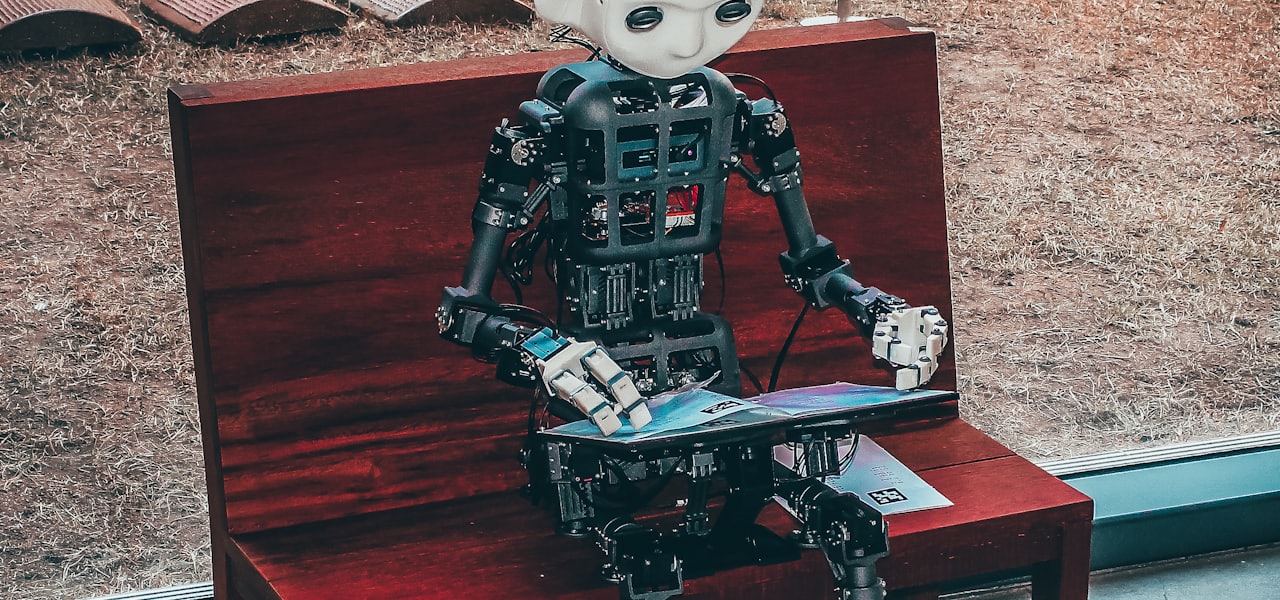
  • Deadbot

    Deadbot

    A deadbot, deathbot, or griefbot is a digital avatar, created with artificial intelligence, which resembles a person who is dead. Griefbots employ natural language processing and machine-learning techniques to approximate the style and personality of a deceased person. They may appear as chatbots, voice assistants, or animated avatars, and are often trained on an individual's digital remains. == History == Among the earliest researchers, Muhammad Aurangzeb Ahmad of the University of Washington, developed the Grandpa Bot project, a conversational simulation of his late father designed for his children to interact with. Other efforts include journalist James Vlahos's Dadbot, which evolved into the commercial platform HereAfter AI. Hossein Rahnama's Augmented Eternity research at MIT Media Lab and Toronto Metropolitan University, and game designer Jason Rohrer's "Project December", have enabled users to converse with language-model representations of loved ones. Early commercial projects such as Eternime, founded by Marius Ursache, also popularized the notion of interactive digital immortality. == Cultural and societal impact == Scholars have proposed frameworks and critiques addressing the ethics of these technologies. Tomasz Hollanek and Katarzyna Nowaczyk-Basińska developed a design-ethics taxonomy distinguishing the data donor, data recipient, and interactant. Edina Harbinja and Lilian Edwards formalized the concept of post-mortem privacy, and Carl J. Öhman at the Oxford Internet Institute studied the management of large-scale digital remains. Cultural acceptance varies: while some view them as expressions of remembrance, others regard them as unsettling or ethically problematic. Concerns have been raised about deadbots' potential for creating psychological harm. Griefbots are considered part of the phenomenon of artificial intimacy.

    Read more →